


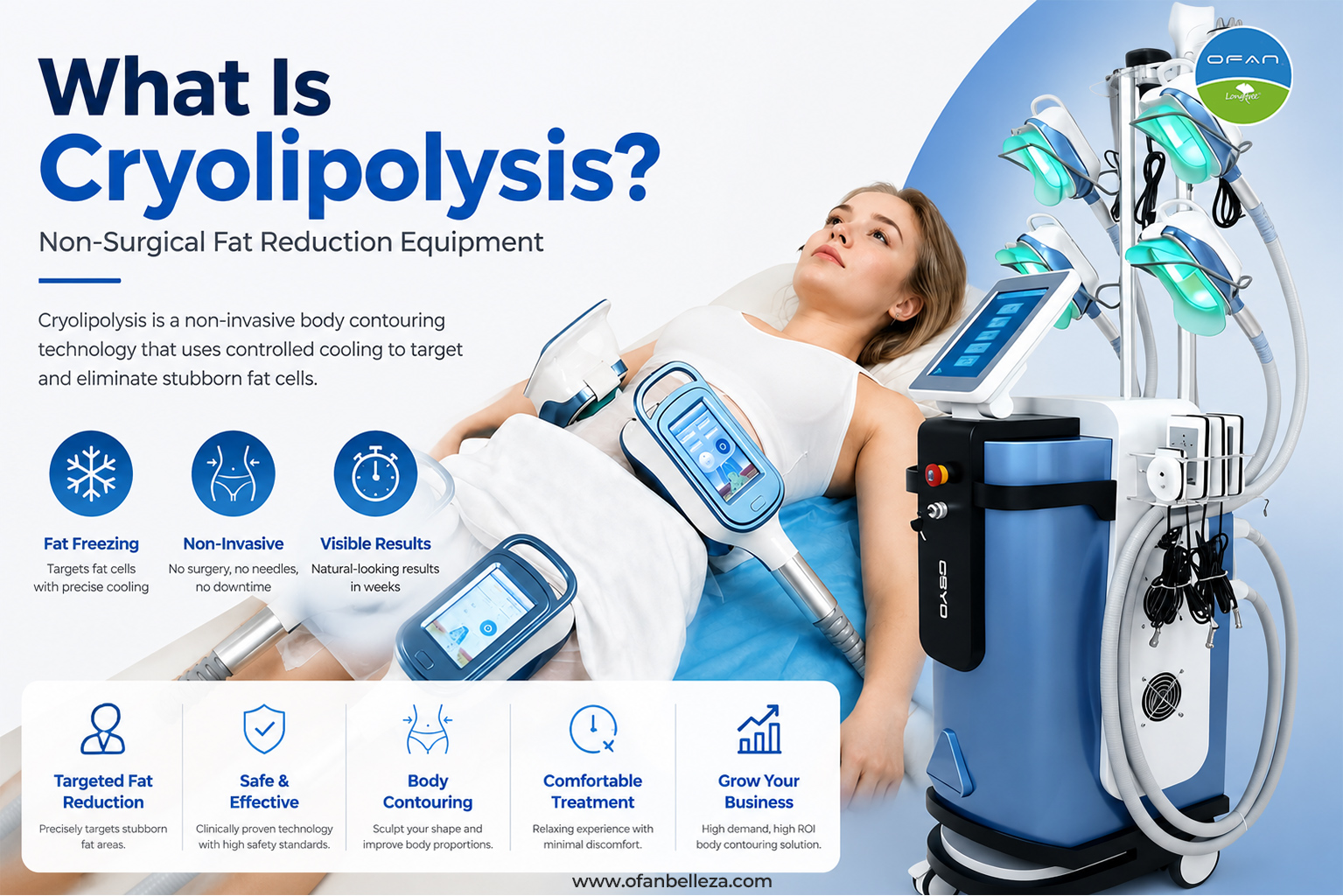
Learn what cryolipolysis is, how cryo slimming differs from fat freezing, what clinics and salons should know before buying a cryolipolysis machine, and how to evaluate safety, training, ROI, and supplier support.
Cryolipolysis is a non-surgical body-contouring technology, not a weight-loss treatment. This article is written for beauty salons, med spas, aesthetic clinics, distributors, and equipment buyers. It is for business education and purchasing reference only. It should not replace local medical, legal, or regulatory advice.
What Is Cryolipolysis?
Cryolipolysis, often called fat freezing, is a non-invasive body-contouring method that uses controlled cooling to target localized subcutaneous fat. The treated fat cells are gradually cleared by the body over time, which may make the treated fat bulge appear smaller.
For B2B buyers, cryolipolysis should not be understood as simply “a machine that freezes fat.” It is a complete service system that includes client screening, treatment planning, staff training, safety documentation, before-and-after tracking, and realistic marketing.
Answer
Cryolipolysis is suitable for businesses that want to add a non-surgical body-contouring service for clients with small, stubborn, pinchable fat areas. It is not suitable to promote as a quick weight-loss solution.
Cryolipolysis vs Cryo Slimming
中文:Cryolipolysis 和 Cryo Slimming 的区别
The terms “cryolipolysis” and “cryo slimming” are often used together, but they do not always mean the same thing. Cryolipolysis usually refers to controlled fat-freezing technology. Cryo slimming is a broader marketing term that may include fat freezing, cold massage, cold wand treatment, or other cold-based body services.
| Item | Cryolipolysis | Cryo Slimming |
|---|---|---|
| Main meaning | Controlled fat-freezing technology | Broad cold-based slimming concept |
| Business risk | Risk comes from poor screening, training, or unrealistic claims | Risk comes from unclear service definition and overpromising |
| Marketing position | Non-surgical localized fat reduction | Cold-based slimming or body shaping |
| Procurement focus | Cooling control, applicators, safety system, training, documentation | Actual technology, treatment depth, evidence, device function |
Questions to Ask a Supplier
- Is this a true cryolipolysis machine or a general cryo slimming device?
- What treatment areas is the machine designed for?
- What safety sensors, alarms, and skin protection systems are included?
- What training, warranty, spare parts, and marketing support do you provide?
What Cryolipolysis Can and Cannot Do for Your Business
A profitable cryolipolysis service starts with accurate positioning. The treatment is easier to sell, deliver, and retain when clients understand that it is for localized body contouring, not dramatic weight loss.
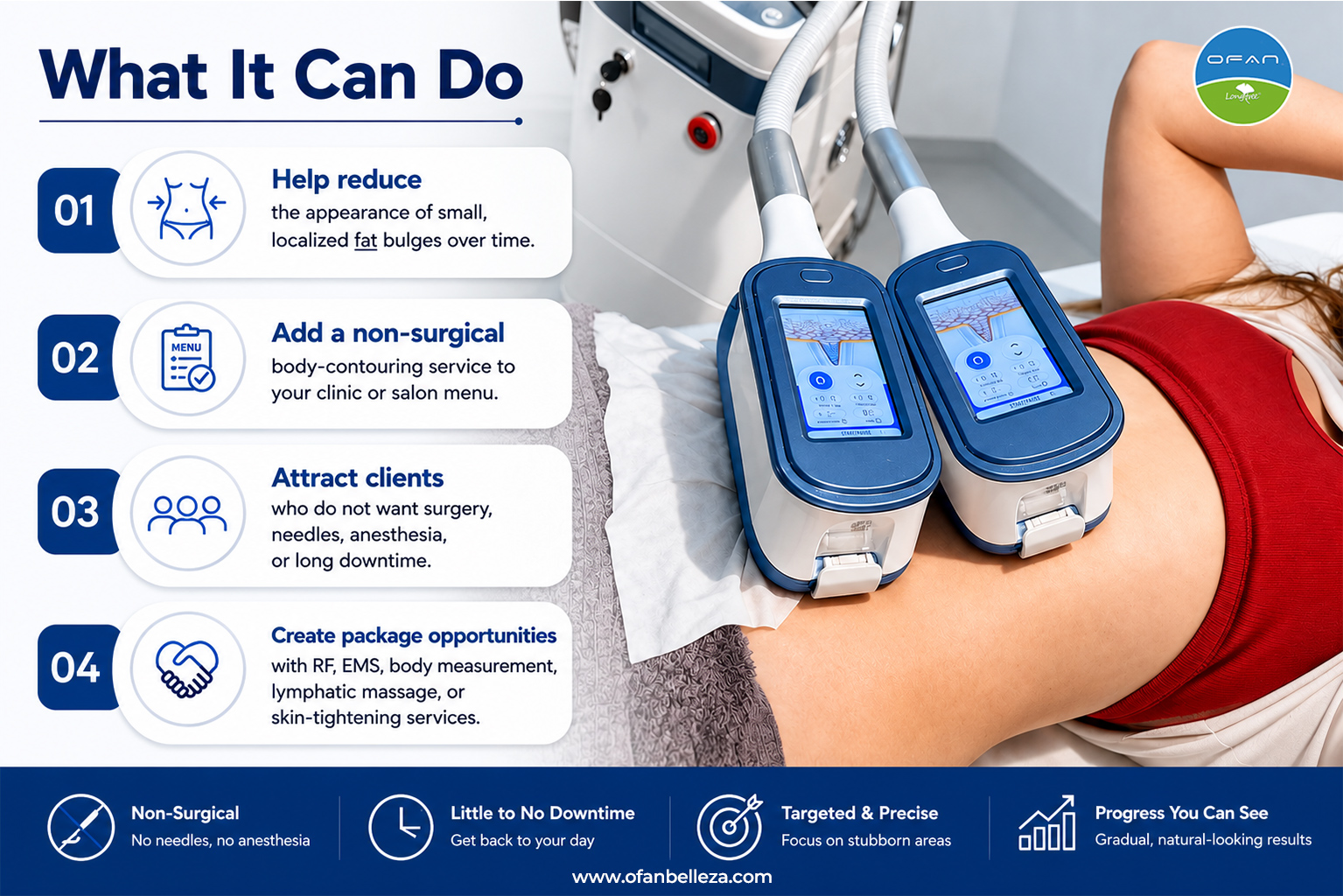
What It Can Do
- Help reduce the appearance of small, localized fat bulges over time.
- Add a non-surgical body-contouring service to your clinic or salon menu.
- Attract clients who do not want surgery, needles, anesthesia, or long downtime.
- Create package opportunities with RF, EMS, body measurement, lymphatic massage, or skin-tightening services.
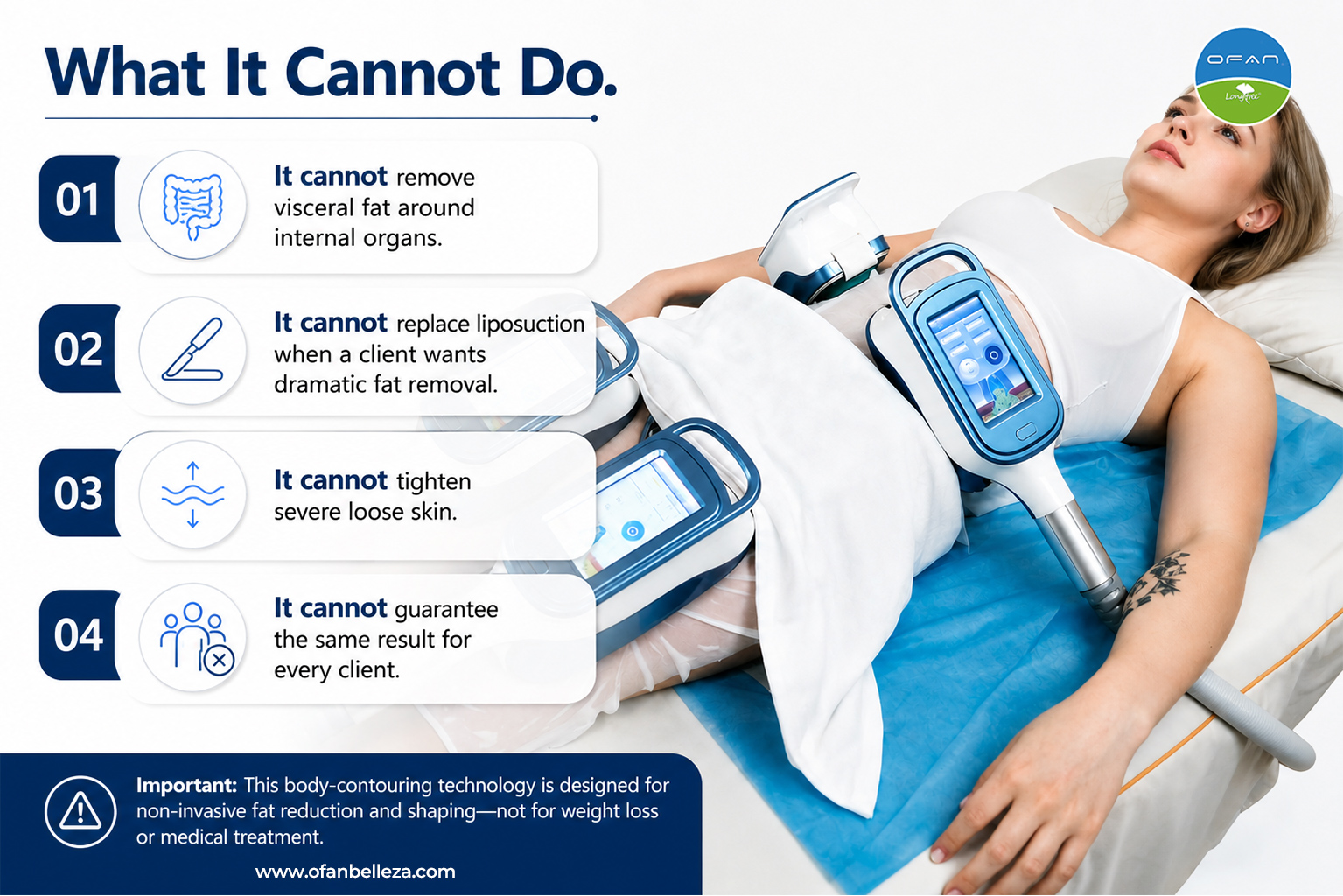
What It Cannot Do
- It cannot remove visceral fat around internal organs.
- It cannot replace liposuction when a client wants dramatic fat removal.
- It cannot tighten severe loose skin.
- It cannot guarantee the same result for every client.
Who It Fits: Ideal Client Profiles for Clinics and Salons
Cryolipolysis works best as a selected-client service. Your staff should know who is suitable before they start selling packages.
Best-Fit Client Types
| Client Type | Why They Fit | Sales Positioning |
|---|---|---|
| Near-target-weight clients | They usually have localized fat, not general obesity | Body contouring, not weight loss |
| Busy professionals | They want low downtime | Non-surgical treatment with easier return to routine |
| Existing body-treatment clients | They already buy slimming, RF, EMS, or body care services | Upgrade their body-contouring plan |
| Post-weight-loss clients | They may still have stubborn local fat pockets | Refine body shape after weight management |
Clients Who May Not Be Suitable
- Clients expecting major weight loss from one treatment.
- Clients whose main concern is visceral fat or general obesity.
- Clients with severe loose skin as the main concern.
- Clients with cold-related medical conditions or poor circulation in the treatment area.
- Clients who refuse consultation records, photos, consent forms, or follow-up.
What a Professional Cryolipolysis Workflow Looks Like
A professional cryolipolysis service is not just turning on a machine. The client experience should feel structured, documented, and safe from consultation to follow-up.
Clinic SOP Table
| Step | Staff Action | Business Purpose |
|---|---|---|
| 1. Lead qualification | Ask about target area, weight stability, health history, and expectations | Reduce unsuitable bookings |
| 2. In-person assessment | Check pinchable fat, skin condition, scars, and body shape | Confirm whether cryolipolysis is appropriate |
| 3. Baseline records | Take photos, measurements, weight, and treatment notes | Protect both client and clinic |
| 4. Safety screening | Review cold sensitivity, circulation, pregnancy, lactation, medical history, and hernia risk | Reduce preventable risk |
| 5. Treatment planning | Select area, applicator, cycle number, and follow-up date | Create a customized treatment plan |
| 6. Consent | Explain expected result, timeline, side effects, PAH, and alternatives | Improve trust and compliance |
| 7. Treatment | Apply skin protection, place applicator, monitor comfort and machine status | Deliver treatment safely |
| 8. Follow-up | Review photos and measurements around 8–12 weeks | Support retention, referrals, and honest results |
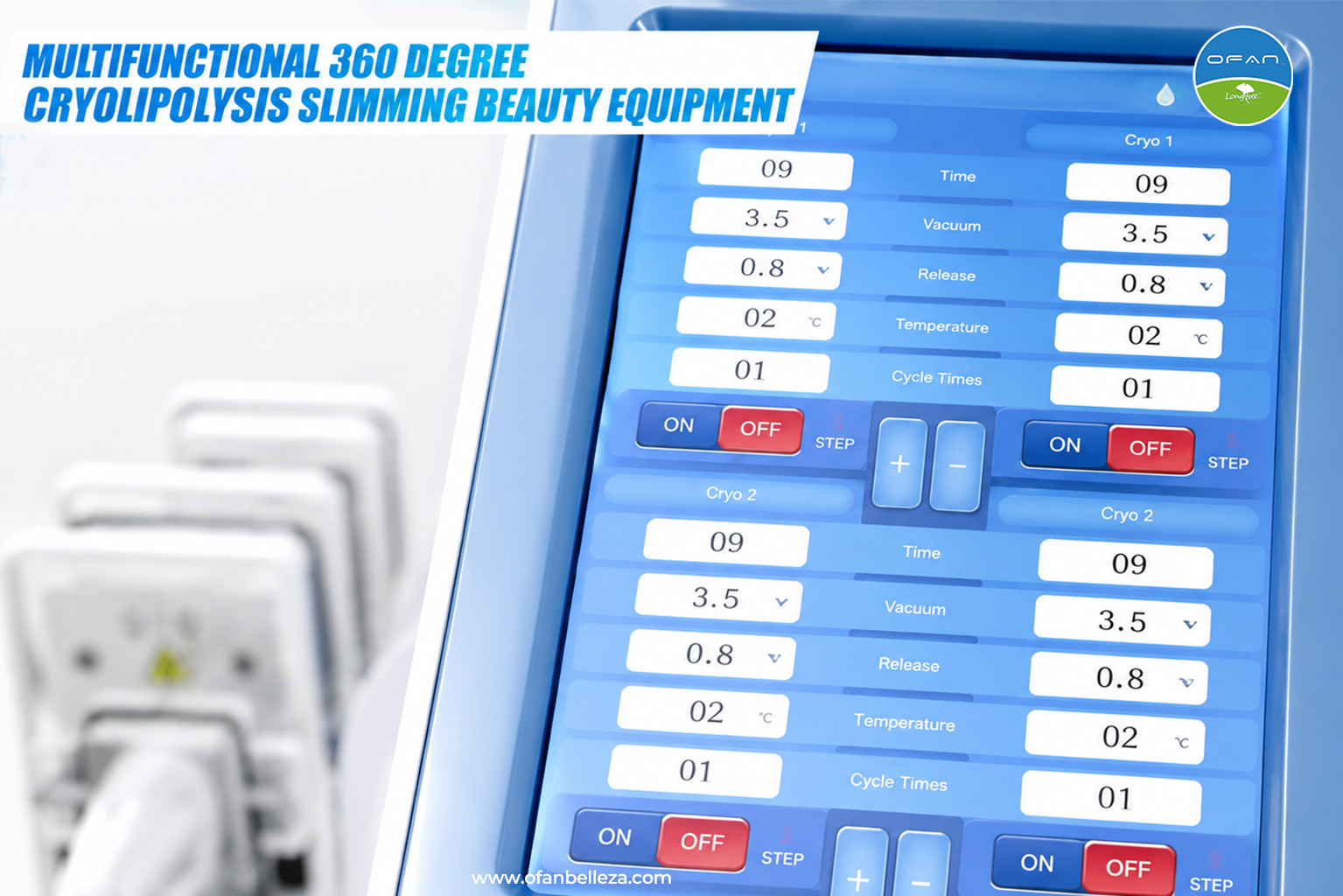
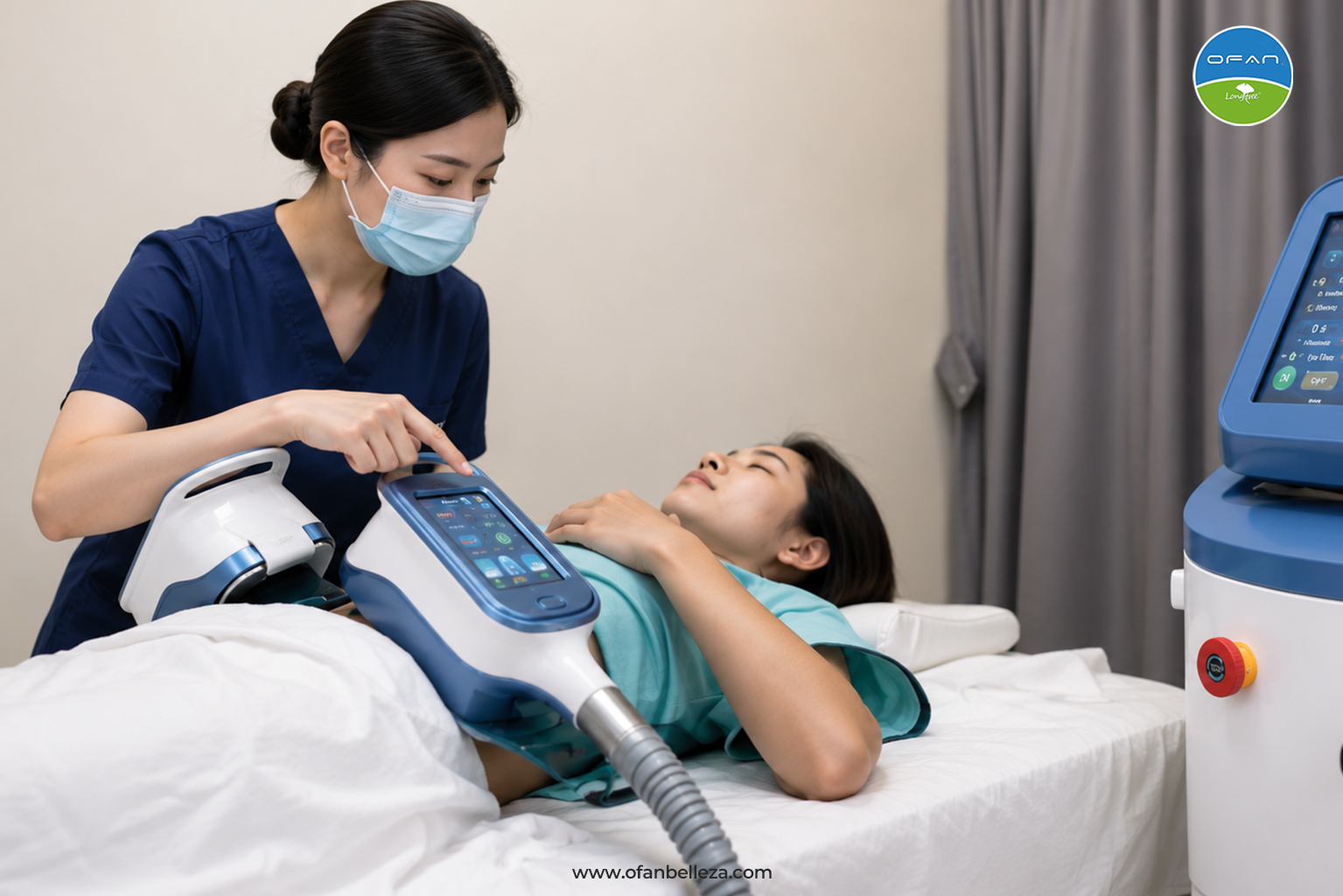
Device Interface During a Demo
Applicator Training
For distributors How to Choose Cryolipolysis Machine device? Contact OFAN today👉Get Quote Nowto discuss your project, product requirements, and cooperation plan.
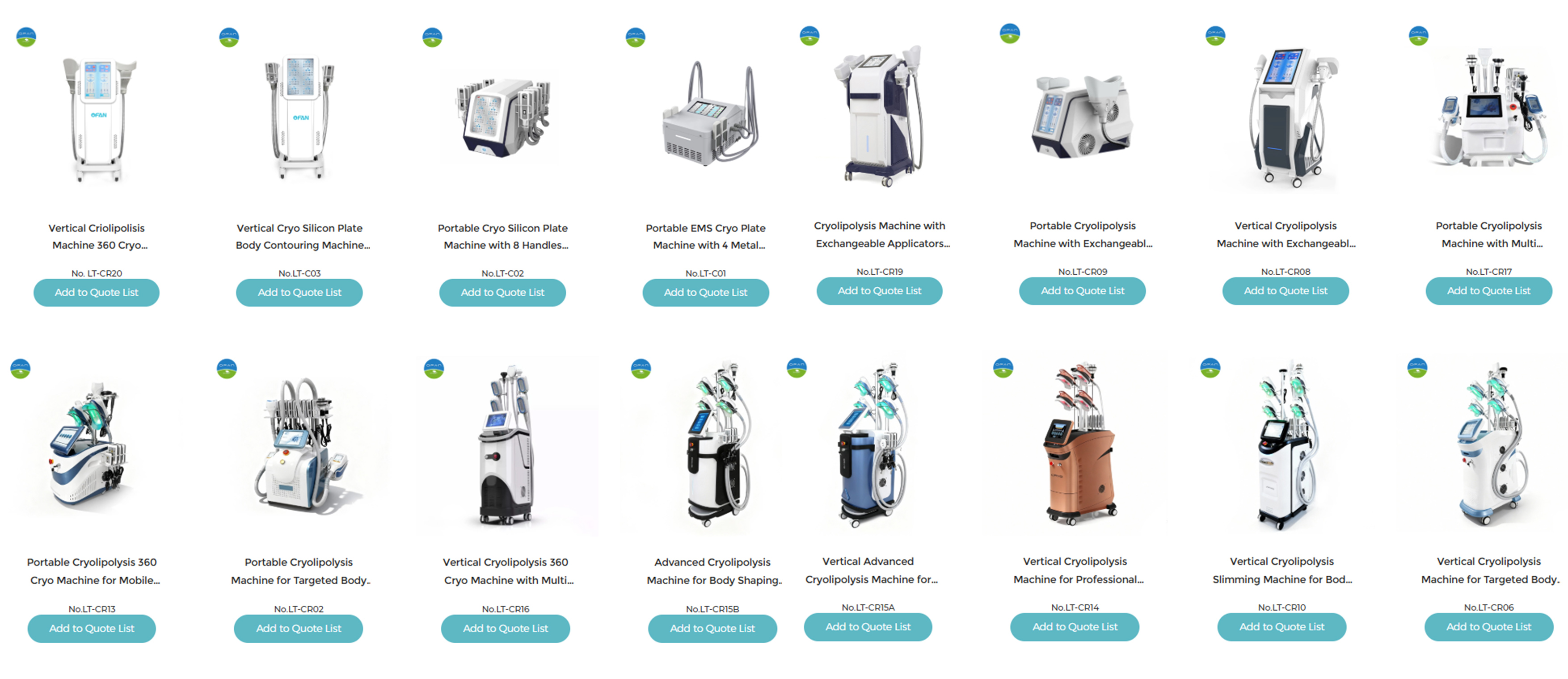
👉Contact OFAN for Cryolipolysis Machine OEM/ODM Device Solutions
👉Click to View: Cryolipolysis Machine Machine
👉READ MORE
Cryolipolysis Machine Buying Guide
The cheapest cryolipolysis machine is not always the most profitable choice. A better question is: can this machine help your team deliver safe, consistent, documented, and repeatable treatments?
Procurement Checklist
| Buying Factor | What to Check | Why It Matters |
|---|---|---|
| Regulatory documents | Certificates, intended use, local compliance | Reduces market-entry and legal risk |
| Cooling control | Temperature stability, sensors, alarms | Affects treatment safety and consistency |
| Applicator system | Sizes, shapes, suction comfort, target areas | Determines treatment flexibility |
| Skin protection | Gel pads, liners, sensors, automatic stop | Helps reduce avoidable injury |
| User interface | Language options, parameter visibility, ease of use | Reduces training difficulty |
| Training support | Manuals, videos, live demo, SOP, troubleshooting | Helps teams deliver consistent service |
| Warranty and parts | Warranty period, repair response, spare parts supply | Reduces downtime and revenue loss |
| Marketing support | Brochures, consultation scripts, before-after templates | Helps sales teams explain the service responsibly |
ROI Planning for Cryolipolysis Equipment
ROI should not be calculated only by dividing the machine price by the price of one treatment session. A more realistic calculation includes utilization rate, staff cost, consumables, advertising cost, maintenance, and repeat purchases.
Simple ROI Formula
- Monthly gross revenue = average treatment price × paid sessions per month
- Monthly net contribution = monthly gross revenue − consumables − staff cost − marketing cost − maintenance cost
- Estimated payback period = total investment ÷ monthly net contribution
ROI Planning Example
| Scenario | Monthly Sessions | Average Price per Session | Monthly Gross Revenue |
|---|---|---|---|
| Conservative | 20 | $150 | $3,000 |
| Moderate | 50 | $180 | $9,000 |
| Strong | 100 | $200 | $20,000 |
Important: These numbers are examples for planning only. Real revenue depends on your location, pricing, staff skill, machine quality, advertising cost, and repeat-purchase strategy.
Safety Overview for Operators
Non-surgical does not mean risk-free. For clinics, salons, and distributors, safety is also a business issue. Poor screening, weak documentation, and exaggerated marketing can lead to complaints, refund requests, negative reviews, and legal risk.
Common Temporary Reactions
- Redness, swelling, bruising, tenderness, or discomfort.
- Tingling, stinging, numbness, or temporary sensitivity.
- Temporary firmness or uneven feeling in the treated area.
Less Common but Important Risks
- Prolonged numbness or nerve-related symptoms.
- Freeze burns or skin injury if skin protection fails.
- Contour irregularity, nodules, or uneven results.
- Paradoxical adipose hyperplasia, also called PAH.
PAH Explanation for Consent Forms
PAH means the treated fat area becomes larger, firmer, and more defined instead of smaller. It is rare but important because it may not resolve on its own and may require surgical correction.
Staff Training: What Your Team Must Learn
A cryolipolysis machine is only as effective as the team operating it. Training should include consultation, screening, applicator placement, skin protection, machine operation, client communication, and follow-up.
Training Checklist
| Training Module | What Staff Should Learn |
|---|---|
| Technology basics | What cryolipolysis is, what it can do, and what it cannot do |
| Client selection | How to identify suitable and unsuitable clients |
| Contraindications | Cold-related conditions, circulation issues, pregnancy, lactation, hernia risk, and skin conditions |
| Applicator placement | Area mapping, fat pinch assessment, symmetry, and client comfort |
| Documentation | Photos, measurements, consent forms, treatment settings, and follow-up notes |
| Sales communication | How to explain results without overpromising weight loss |
How to Package Cryolipolysis Services
A single treatment is easier to sell once. A structured body-contouring program is easier to retain, review, and refer.
Service Menu Ideas
| Package | Includes | Best For |
|---|---|---|
| Trial contouring package | One area, consultation, baseline photos | New clients |
| 8-week body contouring plan | Cryolipolysis, measurements, follow-up review | Clients who want visible tracking |
| Premium shaping package | Cryolipolysis plus RF, EMS, or lymphatic body care | Clients wanting a full body program |
| Membership add-on | Monthly contouring check and selected body service | Existing salon or clinic members |
Sales Script Example
English: “Cryolipolysis is not a weight-loss treatment. It is designed for localized, pinchable fat areas. We first assess whether your area is suitable, record baseline photos and measurements, and then review your progress around 8–12 weeks.”
FAQ for Buyers
Is cryolipolysis suitable for beauty salons?
It can be suitable if local regulations allow it, the device is appropriate for your market, and your staff are properly trained. Beauty salons should avoid medical claims and should use clear screening, consent, and referral procedures.
Is cryolipolysis better for clinics or spas?
Both can use cryolipolysis depending on local regulations and positioning. Clinics may have stronger medical credibility, while spas and beauty centers may benefit from packaging it with body-shaping, RF, EMS, or wellness services.
Can I advertise cryolipolysis as weight loss?
No. It is safer and more accurate to advertise cryolipolysis as non-surgical body contouring or localized fat reduction, not as a weight-loss treatment.
How long does it take clients to see results?
Results are gradual. Some clients may notice early changes after several weeks, while a more meaningful review is usually done around 8–12 weeks or later.
What is the biggest business risk?
The biggest risk is not only equipment failure. It is overpromising results, treating unsuitable clients, weak documentation, and poor follow-up. These problems can create complaints even when the machine itself works properly.
What should I ask a cryolipolysis machine supplier?
Ask about regulatory documents, intended use, temperature control, applicator types, training, warranty, spare parts, consumables, user manual, contraindication guidance, and marketing support.
Final Takeaway
For buyers, cryolipolysis is not simply a fat-freezing machine. It is a complete body-contouring business system.
The right device can help clinics, salons, med spas, and distributors build a profitable non-surgical fat reduction category. But long-term success depends on safe screening, realistic marketing, staff training, treatment documentation, supplier support, and follow-up management.
Before Buying, Ask These Three Questions
- Can this machine safely and consistently deliver the service we want to sell?
- Can our team explain cryolipolysis honestly and professionally?
- Can the supplier support us after the sale with training, documents, parts, and marketing guidance?
If the answer is yes, cryolipolysis can become more than a single treatment. It can become a long-term body-contouring category inside your business.
References
- U.S. Food and Drug Administration: Non-Invasive Body Contouring Technologies
- American Academy of Dermatology: Non-invasive fat removal: What can you expect?
- American Society of Plastic Surgeons: Cryolipolysis / Nonsurgical Fat Reduction
- American Society for Dermatologic Surgery: Cryolipolysis
- Clinical review: Cryolipolysis for Fat Reduction and Body Contouring
- Clinical best practices: Cryolipolysis Clinical Best Practices


